
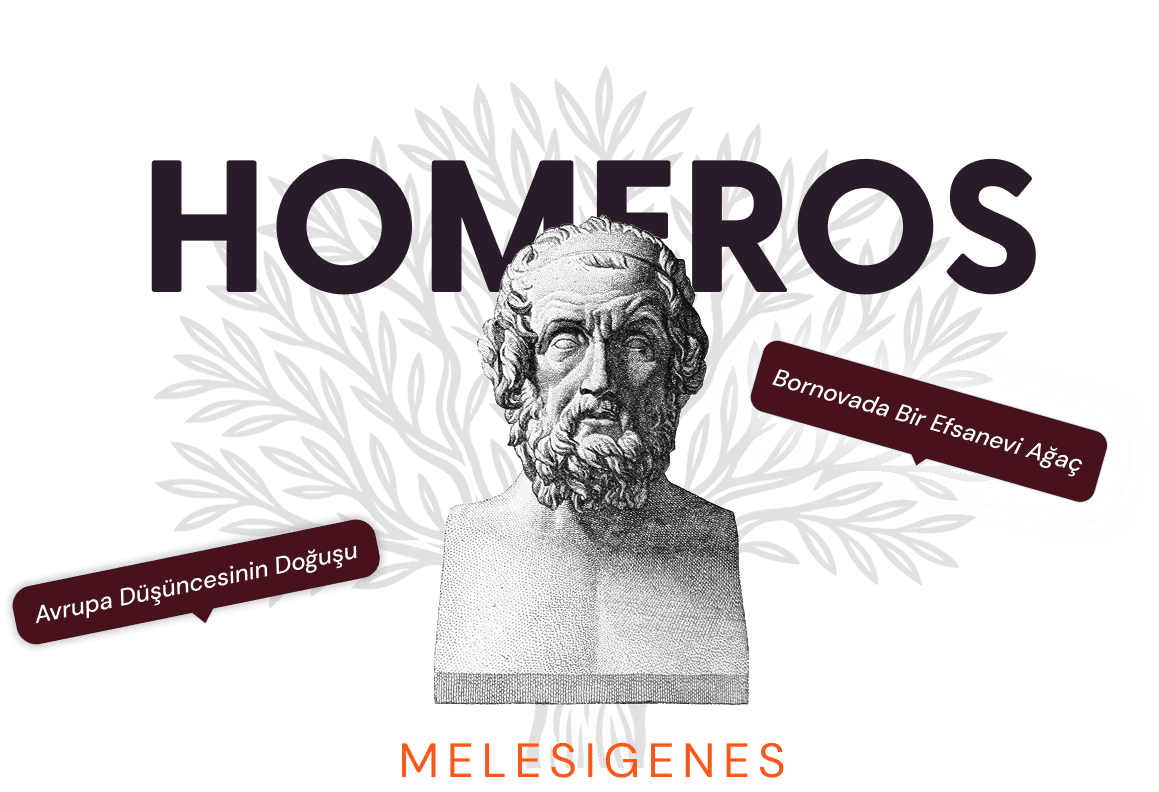
A Legend and a Tree in Bornova
HOMEROS
Homer, the indispensable figure of Western literature, is a figure from Anatolia who has become a universal rather than local icon. The Iliad and the Odyssey, the epics he compiled, are regarded as the starting point of Western culture.
Melesigenes: Son of Meles
After passing a few hundred meters beyond the village of Eğridere in Bornova, if you follow the “Homeros” signs and turn off the main road descending into the valley, you will reach Homer's Caves atop a cone-shaped hillock.
It is believed that Homer, who resided in these caves, compiled the Iliad and the Odyssey — epics that the Western world regards as the starting point of its own culture. They are among the most widely known and influential works in the world.
Homer was in fact Anatolian, yet for some reason he has never quite found a place in the hearts of the present-day people of Anatolia, who themselves became Anatolian some 1,500 to 2,000 years after him.

Ionia: The Birth of European Thought
Cradle of European Culture
The coastal strip between Phocaea (Foça) in the north and Miletus in the south, known in antiquity as Ionia, constitutes the cradle of European culture.
I
Literature
The first works of European literature were created in Anatolian Ionia. Homer is the 'father' of these developments. The Iliad and the Odyssey are the cornerstones of Western culture.
II
Science
The first foundations of European science were laid here. Miletus became one of the most important intellectual and cultural centres of the Aegean, even earlier than Athens. Astronomy and mathematics flourished in Ionia.
III
Philosophy
Ionia is the birthplace of rationalism, the principle linked to the birth of European thought. Thales, Anaximander, and Heraclitus all lived here.
The great poet Homer is the founder of European literature. His two monumental works, the Iliad and the Odyssey, are the first literary works created by the Greeks after living without writing for approximately 400 years, adopting the Phoenician alphabet around 800 BC. Both works were composed in Anatolia during the second half of the 8th century BC. Homer is the 'father' of all these developments.
Origin
Was Homer from İzmir?
Homer composed his epics in a style blending Ionic and Aeolic dialects, both Anatolian dialects. İzmir is the border city between Ionia and Aeolia.
Prof. Dr. Ersin Doğer demonstrated that Homer was from İzmir, using Homer's own verses:
My city is İzmir in the Aeolian land / Since shield-bearing Zeus so ordained / Riding upon proud steeds / Always roaming armed for battle...
Mythological Story
According to Aristotle: Kritheis was taken to Smyrna by pirates and presented as a gift to Maion, King of Lydia. Kritheis died after giving birth to Homer, and King Maion raised the child, named Melesigenes, as his own son.
River God Meles
In Greek mythology, the River God Meles is considered Homer's father. Homer was the son of Meles and the water nymph Kritheis, and for this reason he was given the name “Melesigenes” (Son of Meles).
Legacy of Smyrna
The Smyrnaeans built a temple (Homerion) in Homer's honour and depicted the River God Meles on their coins. Throughout history, Smyrna always claimed Homer as one of its own.
Location
Where Did Homer Live in İzmir?
In numerous historical documents, Homer's name appears as Melesigenes — meaning the Child of the River God Meles.
Historical sources mention that Homer lived in caves near the source of the River Meles. Although there is no clear consensus among modern historians as to which river in İzmir historically corresponded to the Meles, for centuries four small caves on a rocky outcrop along the Bornova stream, north of Bornova have been accepted as the caves where Homer lived.
These caves have been visited by many European travellers, writers, and scholars, and have been featured in the press and books since the early 1800s.
Historical Testimonies
Homer's Caves in Travelers' Notes
While Daskalopetra on the Greek island of Chios is a world-renowned tourist destination, Homer's Caves in Bornova — which until the early 20th century were a frequent stop for numerous Western travellers — still await their moment on the international tourism stage.
Vikont De Marcellus
“I especially wanted to see Homer's caves and the course of the Meles. I owe this sacred journey to the pious admiration I feel for the divine poet. On Chios I had seen the places where he lived; on the island of Ios I had seen the rock where his tomb is said to lie; all that remained was to see the place said to be his cradle…”
Otto Friedrichs von Richter
“On the morning of 20 July 1815, I went to Bornova Pier by boat. Hiring two donkeys and a guide, I passed through a landscape partly of olive groves, partly scrubland, with occasional conifers, until I reached a point where there were four small passages that could not have been carved by human hands — these passages are called Homer's Galleries. A tomb had been carved at the very top.”
Video
Videos
Short talks on Homer and Bornova
Historical Documents
Depictions of Homer
Over the centuries, artists and travellers have made Homer and the caves of Bornova the subject of their works.
1663
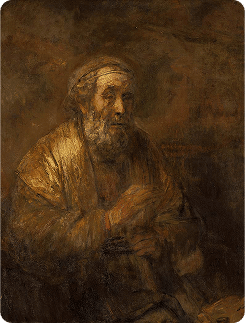
A depiction of Homer painted by Rembrandt in 1663. The painting was commissioned by the Sicilian nobleman Antonio Ruffo. The original version of the painting included a scribe recording Homer's words, but this section was unfortunately damaged in a fire. In the lower right, two fingers still holding a pen and paper can be seen.
1838

The archaeologist Joseph Leon Emmanuel Laborde visited Bornova in 1838 and produced this engraving.
1852
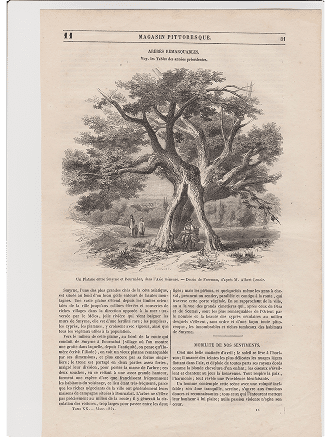
In this engraving from the March 1852 issue of Magasin Pittoresque magazine, while describing a legendary tree found in Bornova, the caption beneath the image mentions that Bornova is said to be the place where Homer compiled the epics of the Iliad and the Odyssey.
1830

The traveller and writer Joseph d'Estourmel, who came to Bornova in 1830, visited Homer's caves and produced this charcoal drawing. The original of this drawing is held in the Aristotle Onassis Foundation library in Athens.