

Location Info
Square
Kazımdirik
Located in the center of Bornova, Abide-i Hurriyet Square is a place of memory that keeps alive Turkey's struggle for freedom through its monument dedicated to the martyrs of the March 31 Uprising, its historical figures, and cultural symbols. Bornova's Abide-i Hurriyet Square was inaugurated on April 27, 2025, on a 2,700-square-meter area between Sanayi and Universite Avenues, right next to Yasar University...



Abide-i Hurriyet Square (Liberty Monument Square)
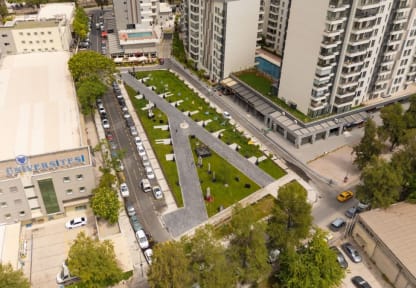
Located in the center of Bornova, Abide-i Hurriyet Square is a place of memory that keeps alive Turkey's struggle for freedom through its monument dedicated to the martyrs of the March 31 Uprising, its historical figures, and cultural symbols. Bornova's Abide-i Hurriyet Square was inaugurated on April 27, 2025, on a 2,700-square-meter area between Sanayi and Universite Avenues, right next to Yasar University...
Brief Description
Situated in the heart of Bornova, Abide-i Hürriyet Square is a place of remembrance that honours Turkey's struggle for liberty through its monument dedicated to the martyrs of the 31 March Uprising, its historical figures and cultural symbols.
The Story of the Square
Bornova's Abide-i Hürriyet Square was inaugurated on 27 April 2025 on a 2,700-square-metre site between Sanayi and Üniversite Avenues, adjacent to Yaşar University. The square takes its name from the Abide-i Hürriyet (Liberty Monument) erected in Şişli, Istanbul, between 1909 and 1911 in memory of those who suppressed the 31 March Uprising during the final years of the Ottoman Empire. The monument in Bornova is an exact replica of the original, standing as a powerful expression of reverence for history.
Historical Background and Significance
The 31 March Uprising is recorded in history as one of the gravest threats to the Ottoman constitutional order and modernisation process. Its suppression ensured the continuation of constitutional rule and marked a critical turning point in Turkey's journey towards modernity. The square in Bornova serves as an open-air museum with both educational and cultural-memorial functions, aiming to convey this historical moment to future generations.
The Entrance Area
At the entrance stands a bust of Gazi Mustafa Kemal Atatürk, founder of the Republic. Atatürk's handwritten definition of "Turkishness," penned for Afet İnan, is displayed on a specially crafted plaque, faithfully reproduced from the original. This definition forms the cornerstone of the themes of historical identity and national memory that pervade the entire square.
The entrance section also features the founders and flags of 17 great Turkic states. This area reminds visitors of the millennia-long continuity of the Turkic tradition of statehood.
To the right of the entrance, three notable figures greet visitors:
Ali Suavi (1839–1878)
One of the militant intellectuals of Turkish thought, Ali Suavi was among the first advocates of Turkism. He is remembered as the "Turbaned Revolutionary" for his attempted coup against Abdülhamid II.
Namık Kemal (1840–1888)
Known as the "Poet of the Homeland" and the "Poet of Liberty," Namık Kemal used his pen to inspire a popular movement, transforming the love of freedom and homeland into an intellectual current. He was one of the figures who most deeply influenced Atatürk.
Mithat Paşa (1822–1884)
The architect of the Kânûn-ı Esâsî, the first Ottoman constitution. His reformist identity inspired numerous statesmen, and he is regarded as a pioneer of modernisation.
The Heart of the Square: The Liberty Monument
At the centre of the square stands the Abide-i Hürriyet, dedicated to the martyrs of the 31 March Uprising. This meticulously crafted monument symbolises a cannon firing into the air and serves as a powerful narrative of the struggle for liberty.
Alongside the monument are the following historical elements:
- The Committee of Union and Progress flag
(bearing the concepts of Justice, Liberty, Fraternity, Equality and Union) - An inscription recounting the 31 March Incident
- An inscription introducing the Committee of Union and Progress
Pioneers of the Second Constitutional Era and the Committee of Union and Progress
Surrounding the monument are busts of the leading figures of the Committee of Union and Progress:
- Mahmut Şevket Paşa (1856–1913)
The key military figure in the proclamation of the Second Constitutional Era and the suppression of the 31 March Uprising. - Cemal Paşa (1872–1922)
One of the pioneers of modernisation; noted for his military and administrative roles. - Talat Paşa (1874–1921)
One of the most influential statesmen of the late Ottoman period; Grand Vizier in 1917. - Resneli Niyazi Bey (1873–1913)
Known as the "Hero of Liberty"; he played a decisive role in the proclamation of the Second Constitutional Era. - Mithat Şükrü Bleda (1874–1956)
One of the ideologues of the Committee of Union and Progress; diplomat, thinker and author.
The Historical Triad: Three Great Figures of Anatolia
Opposite these busts stand sculptures gazing towards three different horizons of history:
- Hector → Facing Çanakkale
The Trojan hero of Homer's Iliad, symbol of honour and resistance. - Fatih Sultan Mehmet → Facing Istanbul
The conqueror of Constantinople, the sovereign who closed one era and opened another. - Gazi Mustafa Kemal Atatürk → Facing Ankara
Founder of the Republic and architect of modern Turkey.
This triad symbolically unites thousands of years of Anatolian history along a single axis.
Cultural and Mythological Symbols
Beyond the three sculptures, the next section delves into the deeper roots of Turkic history:
- The Orkhon Inscriptions
The earliest written sources of Turkic identity. - The Great Birch Tree
The sacred tree representing life, wisdom and continuity in Turkic mythology. - The tamgas and stories of the Oghuz tribes
Narrating the ancient structure and cultural continuity of Turkic communities.
Walking from one end of the square to the other, visitors experience a chronological journey through the "Great Turkic History."