
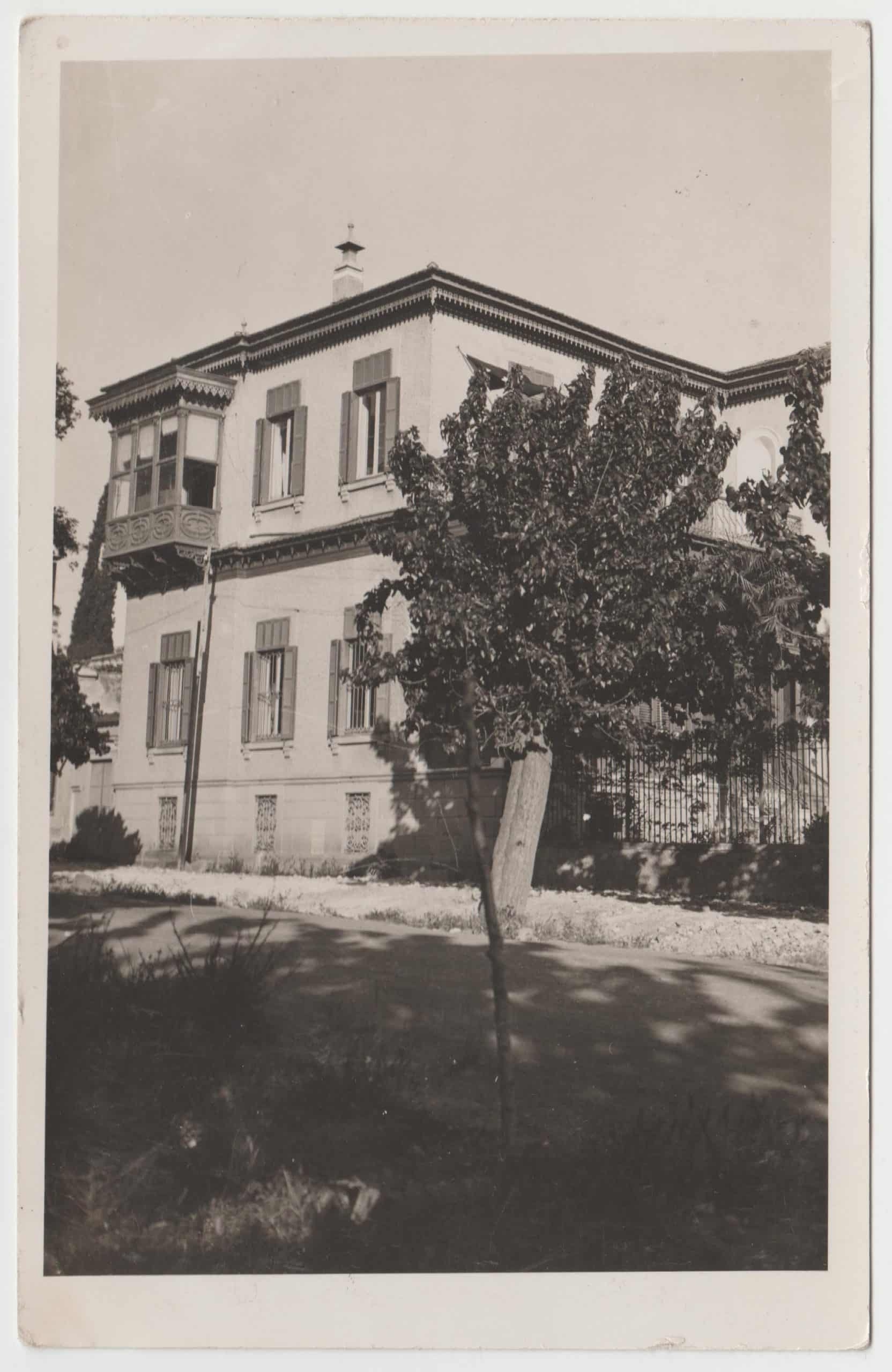
Tristram Mansion
The Tristram Mansion was built in 1904 by the British Tristram Family. One of the family's notable members is Uvedale Barrington Tristram (1826-1898).
The Tristram Mansion was built in 1904 by the English Tristram family. One of the family's known representatives is Uvedale Barrington Tristram (1826–1898).
Between 1948 and 2010 the building was used as the Agricultural Pest Control Institute under the Ministry of Agriculture and Rural Affairs; from 2021 it has served as the İzmir Literature Museum Library under the Ministry of Culture and Tourism.
Among the notable objects on display here are the first edition of Atatürk's Geometry textbook, a signed work by Halit Ziya Uşaklıgil, and the flat cap of the poet Attilâ İlhan.
Introduction
Built in 1904 by the English Tristram family, the mansion is one of the characteristic examples of the late Levantine residences in Bornova.
The building is notable for its mixed stone-and-brick walling, symmetrical façade and plan reflecting the residential architecture of the period.
History and Ownership
According to title-deed records, the mansion remained in the ownership of the Agricultural Pest Control Research Institute Directorate, affiliated with the Ministry of Agriculture and Rural Affairs, from 1948 to the second half of the 2010s.
During this period the building's interior was modified to suit laboratory and administrative use.
In the 2010s ownership was transferred to the Ministry of Culture and Tourism; following restoration and repurposing, the building reopened in September 2021 as the İzmir Literature Museum Library.
Present Use — İzmir Literature Museum Library
Today the Tristram Mansion houses a special collection of works, letters and personal belongings of writers who were born in İzmir or lived there for many years.
The archive, created on a museum-library basis, contains:
- Signed books by İzmir-born writers and poets,
- Personal belongings of authors (Attilâ İlhan's flat cap, Halit Ziya Uşaklıgil's book inscribed to his nephew Ali Ekrem in 1934, the first edition of Atatürk's 1937 Geometry textbook),
- Facsimiles of manuscripts, typewriters, pens and various literary objects.
This collection is one of the important examples representing the transformation of Bornova's Levantine residential heritage into a public cultural institution during the Republican period.
Architectural Features
The two-storey building was constructed with brick walling on a stone foundation.
It is defined by a broad central-hall plan, symmetrical window arrangement and a plain façade.
The high ceilings and large windows reflect the spatial characteristics peculiar to Levantine residential architecture.
The garden, with its ornamental planting and pathways, carries the open-space arrangement of the building's residential era into the present day.
Cultural Significance
The Tristram Mansion is one of the rare buildings that preserves Bornova's late Levantine architecture and brings it into cultural life.
Designed a century ago as a residence, the building today symbolises the city's cultural continuity as a museum library keeping alive İzmir's literary memory.
Photo Gallery
Location Info
The Tristram Mansion was built in 1904 by the British Tristram Family. One of the family's notable members is Uvedale Barrington Tristram (1826-1898).


