
Location Info
Religious Building
Erzene
The structure is located in Bornova's Cumhuriyet Square. Built on a north-south axis, the building's inscription reads: "In the year of our Lord 1831, the Reverend Father Isodoro da Boscomari, fulfilling the rule of Saint Franciscus, with the capital contribution of the Istanbul Mission, the Capuchin Fathers and currently apostolic delegate, had this building constructed from its foundations in the name of the Blessed Virgin Mary."...


Santa Maria Church
The structure is located in Bornova's Cumhuriyet Square. Built on a north-south axis, the building's inscription reads: "In the year of our Lord 1831, the Reverend Father Isodoro da Boscomari, fulfilling the rule of Saint Franciscus, with the capital contribution of the Istanbul Mission, the Capuchin Fathers and currently apostolic delegate, had this building constructed from its foundations in the name of the Blessed Virgin Mary."...
The building is situated in Bornova's Cumhuriyet Square. Orientated on a north–south axis, the inscription on the building reads: "In the year of our Lord 1831, the Reverend Father Isodoro da Boscomari, observing the Rule of Saint Francis, with capital contributed by the Istanbul Mission, the Capuchin Fathers, and the presently Apostolic Authority, caused this building to be erected from its foundations in the name of the Blessed Virgin Mary." Within the scope of her oral-history studies, Hale Okçay notes that the church was first built in 1625 by the Whittall family — one of the earliest Levantine families to settle in Bornova — and was completely destroyed in a fire in 1630. Hasan Mert, on the other hand, records that the building was first constructed in timber in 1797 by the Franciscan Order with contributions from Roman and Armenian Catholics, and was rebuilt in stone in 1832 by decree of Sultan Mahmud II. Ergun Laflı's research likewise states: "Sta. Maria (in Bornova) was built in 1831 and has been in continuous use to the present day." Since its foundation, the church has been dedicated to the worship of the Italian-origin Catholic (Levantine) congregation; tombstones belonging to numerous Levantine families in the surrounding cemetery have survived to the present. With the advent of the Republican period, the building underwent several alterations. During the rearrangement of Bornova's Cumhuriyet Square in the 1970s, the church grounds were reduced and part of the structure was nationalised.
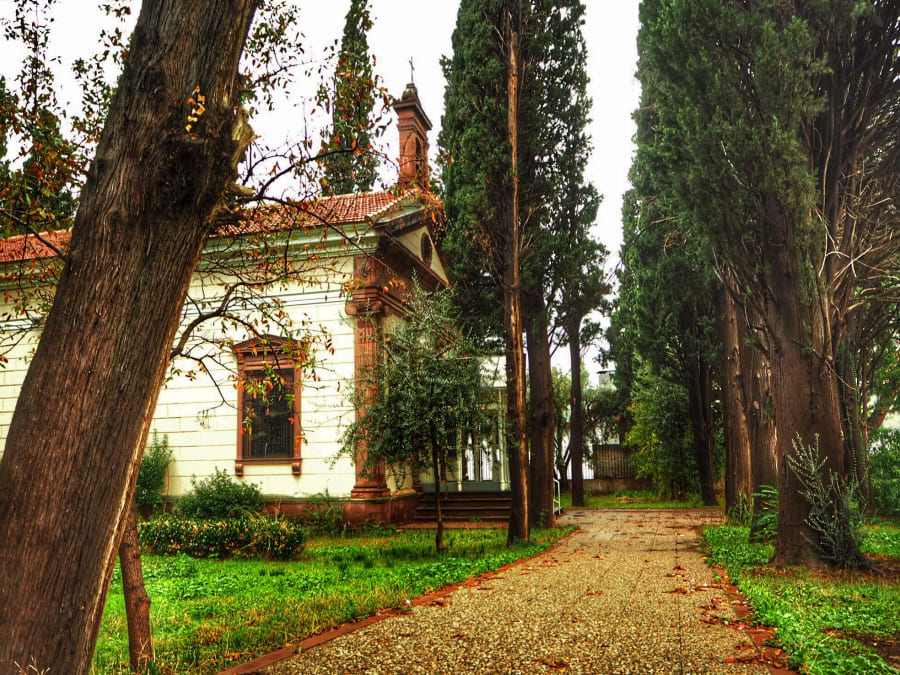
The building, which has a modest entrance between shops on the northern side, is enclosed by a high garden wall. Entry is through a three-arched opening. One of İzmir's five parish churches, the building is distinguished from the others by its rotunda-plan nave. In this structure, where the bema (the area housing the altar) and synthranon (the seating area for clergy) follow a rectangular plan, octagonal-plan chapels projecting outward adjoin the synthranon. The nave is covered internally by a dome and externally by an octagonal spire. Above the entrance opening, a depressed-arched balcony opens onto the nave and is also accessible from outside the church by means of a bridge. Although formerly used as an organ gallery, it has lost this function today. The bell tower rises above the building in a baldachin form.
Examining the decorative scheme, one finds that whilst the exterior is restrained, the interior is richly ornamented. The outer walls are articulated with arches. At the centre of the dome covering the nave, a white dove motif is employed to emphasise the Holy Spirit. The building is also adorned with botanical and geometric patterns, and stained-glass windows depicting scenes from the Gospels are particularly notable. In sum, the decorative programme of the Santa Maria Catholic Church is confined to the religious iconography of the glass windows and light interior decorative painting; the emphasis lies not on outward ostentation but on interior illumination and historical atmosphere.
Ezel Kurmuş / Art Historian
ONLINE SOURCES
Beiträge zur Kenntnis der osmanischen Kirchenarchitektur im Großraum İzmir-Smyrna (19. Jh.–1922)
A Franciscan Church: Santa Maria – İzmir Dergisi – Yaşasın Dergicilik, https://izmirdergisi.com/tr/turizm/inanc-turizmi/1876-bir-fransiskan-kilisesi-santa-maria#google_vignette
https://web.archive.org/web/20200224112940/http://www.levantineheritage.com/borchur2.htm