Location Info
Mansion
Erzene
Known today as the "Green Mansion" (Yesil Kosk), Bardisbanian Mansion is estimated to have been built by D.A. Bardisbanian, an Izmir-based merchant engaged in import and export trade in the last quarter of the 19th century. The mansion, situated directly across from the Bornova train station and at the edge of fertile agricultural lands opening onto the Bornova Plain, represents a distinctive example of Levantine settlement culture...


Bardisbanian Mansion
Known today as the "Green Mansion" (Yesil Kosk), Bardisbanian Mansion is estimated to have been built by D.A. Bardisbanian, an Izmir-based merchant engaged in import and export trade in the last quarter of the 19th century. The mansion, situated directly across from the Bornova train station and at the edge of fertile agricultural lands opening onto the Bornova Plain, represents a distinctive example of Levantine settlement culture...
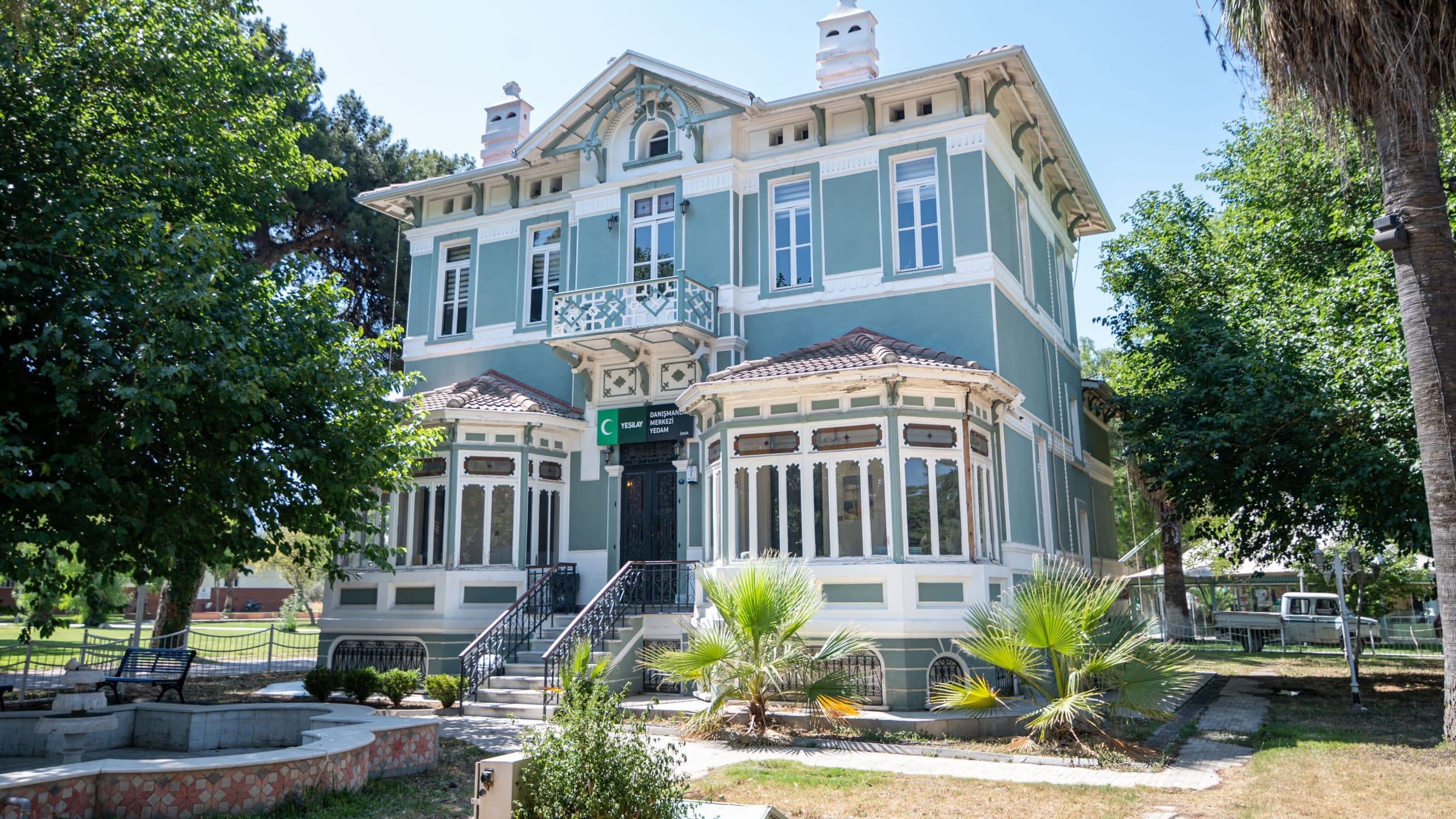
Known today as the "Green Mansion" (Yeşil Köşk), Bardisbanian Mansion is thought to have been built in the last quarter of the 19th century by D.A. Bardisbanian, an İzmir-based merchant engaged in import and export trade. Standing directly opposite the Bornova railway station at the edge of fertile farmland opening onto the Bornova Plain, the mansion represents a distinctive example of Levantine settlement culture.
History and Ownership
Bardisbanian → Gasparian → Nationalisation → University
- Late 19th century: Following the Bardisbanian family's emigration to France, the mansion passed to the Gasparian family.
- After the Gasparian family also departed from İzmir, the building was nationalised for the Bornova Agricultural School.
- 1949: The mansion was transferred to the Treasury of the Republic of Turkey.
- 1955–1972: With the founding of Ege University, the building served as the Department of Agricultural Economics, Faculty of Agriculture.
- 1986: A major renovation was undertaken, after which the building functioned for a time as a guesthouse for distinguished university visitors.
- 1990: The building was formally allocated to Ege University.
- 1993 and 1995: Comprehensive restorations were carried out by the university.
- 1995–2015: The building served as a cafeteria-restaurant for academic and administrative staff and students.
- 2015–2025: The building underwent extensive maintenance and was subsequently repurposed as a Green Crescent Counselling Centre.
Historical Context Note
Period photographs document that during the Greek occupation of 1919–1922, the open area behind the Green Mansion was used as an assembly ground for Greek artillery units.
Architectural Features
Bardisbanian Mansion exhibits architectural characteristics typical of 19th-century Levantine residential design in Bornova:
- Two-storey massing
- Stone ground floor and brick upper storey
- Symmetrical front elevation
- Broad-eaved roof
- Garden-set entrance arrangement
- Planning characteristics shared with English-influenced Bornova mansions
Note: Of the elements associated with Pandespanian Mansion in draft references, only those belonging to the common typology — stone ground floor–brick upper storey, symmetry and garden setting — have been included; features such as double-arm staircase and portico, not present in Bardisbanian, have been omitted.
Transport and the Railway Context
The mansion stands opposite the Bornova Station of the İzmir–Kasaba Railway, established in 1865 on the initiative of Levantine families. Its location reflects the close relationship that the Levantine families of the period maintained with networks of agriculture, commerce and transport.
Present Use (2025)
The building, whose conservation and maintenance are managed by Ege University, currently serves as:
- Green Crescent Counselling Centre
- Counselling rooms
- Meeting and consultation spaces
It is still popularly known as the "Green Mansion" on account of the colour of its façade.
Note: Public Recognition
In an article published by Hürriyet Seyahat on 16 January 2018, the Green Mansion was listed by Selim Onat among "Turkey's ten most magnificent mansions."