Historic Buildings
Discover Bornova's past through its architectural heritage spanning from mansions to public buildings, mosques and churches.

Known as the "Big House," the C. Whittall Mansion is one of Bornova's oldest Levantine residences. Built on the site of a monastery originally constructed for Dutch nuns in the early 18th century, the building was purchased by James Whittall in the 1820s. Expanded by Charlton Whittall after 1867, the mansion today serves as the Ege University Rectorate.

Thought to have been built as a Levantine mansion in the late 19th century, the building was previously used by the Mavrocordato and Boscovich families. Serving as Hilal Primary School during the Republican era, the building has been used as the Bornova Public Education Center since 1963.

Built in 1880, the Belhomme Mansion is one of Bornova's most elegant Levantine buildings, with its eclectic facade design bearing traces of Italian civil architecture. Its first owner was Greek-Catholic merchant Pierre Xenoupoulo, followed by the Belhomme Family. Restored in 1997, the building today serves as the Bornova Municipality Ataturk Library.
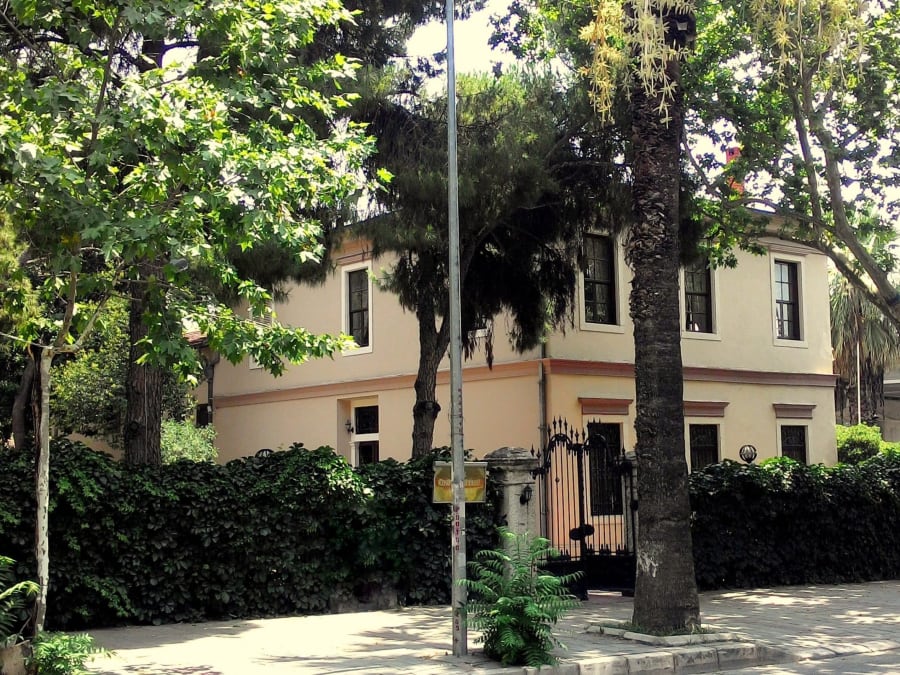
Located at the entrance of Fevzi Cakmak Avenue, the Pasquali (Barry) Mansion was built between 1835 and 1840 by merchant Giuseppe Pasquali, who migrated from the island of Chios to Izmir. After Giovanni Pasquali's death in 1925, the mansion passed to his family and was expropriated in 1941 and transferred to the Bornova Agricultural School. Today it operates as a private cafe-restaurant.

Built in the second half of the 19th century for the Levantine Ballian Family, the mansion is notable for its ornate ceiling medallions and elegant interior details. Purchased by Esther Marian Giraud (Wilkinson) in 1900, the building was transferred to Ege University in 1970. Today it serves as the Paper and Book Arts Museum.

The mansion on 80th Street was built between 1854 and 1856. Ownership of the house successively passed to the Douglas Paterson, Edwin Charnaud, De Zandonati, James Gout, and Victor Whittall families. Restored by its last owner Lucien Arkas, the house currently operates as the Arkas Maritime History Center, housing a very rich collection of maritime history artifacts.

The Aliberti (Wolf) Mansion is an important Levantine residence built in the mid-19th century. Although there are differing accounts regarding its first occupants between the Wolf Brothers and the Paterson Family, the mansion also hosted the La Fontaine Family in the early 20th century. It has been used by the Aliberti Family since the 1950s.

Located at the entrance of Fevzi Cakmak Avenue, the Aliotti (Michel Topuz) House was built in the 19th century by the Aliotti Family, one of Bornova's prominent Levantine families. The building later passed to the Topuz Family and has largely preserved its original Levantine architecture. Today it operates as a dental clinic.

Thought to have been built in the late 19th century, the Alain Giraud House is located on Bornova's 83rd Street. Its first known occupant was Alain Giraud of the Giraud Family. As of 2024 used as an educational institution, the house is said to have hosted Keriman Halis Ece, the first Miss Universe, according to local legend.

Located on Salih Omurtak Avenue in the Isikkent neighborhood, this small Ottoman-era fountain was built in the same period as the Carsi Mosque. Only a column fragment and part of its mirror stone have survived to the present day. Despite its modest form, it reflects the historical importance of water culture in neighborhood life.

Located in the Ergene neighborhood at the II. Yaka locality, the Fatima Hanim Fountain was built in 1868 in the name of Fatima Hanim, daughter of Evliyazade Haci Mustafa Aga of Izmir. The square-plan structure is also known as "Kurtlu Fountain" today. It is one of the rare charitable fountains commissioned through women's donations during the Ottoman period.

Located at the corner of Fevzipasa Avenue and Kivanc Avenue in the Altindag neighborhood, this Ottoman-era fountain is notable for its single-facade form with a round arch and triangular pediment. Although its inscription has been damaged, its decorative details date to the late 19th or early 20th century. It is one of the well-preserved examples of public water architecture in Bornova.