Historic Buildings
Discover Bornova's past through its architectural heritage spanning from mansions to public buildings, mosques and churches.
 Mansion
Erzene
The site where Charlton Whittall Mansion stands was a monastery built for Dutch nuns in the early 18th century. Later, a single-story residence was built by a Dutch immigrant. James Whittall, one of the famous Levantine families who settled in Izmir in 1817, purchased this house in the 1820s. After his death, the property passed to his brother Charlton Whittall. As the family expanded and renovated the structure, the mansion became one of Bornova's...
 Train Station
Kazımdirik
Edward Price, representative of The Smyrna Cassaba Railway Company, which had been authorized with a concession to build the planned railway line between Izmir and Turgutlu, had requested a separate concession for the construction of a new railway line from Izmir to Birunabad (Bornova). The purpose was to serve the Levantines living in Bornova and their...
 Mansion
Kazımdirik
Belhomme Mansion — originally known as Xenopoulou Mansion — was built in the 1880s by the English-origin Wolf Brothers. One of the mansion's first known owners was Greek-Catholic merchant Pierre Xenoupoulo, followed by the Belhomme Family. The family's last Levantine representative, Helen Armand, was among the mansion's residents in the mid-20th century. In the 1950s, ownership passed to a Turkish family, and in the 1960s the mansion was nationalized...
 Mansion
Erzene
Known today as the "Green Mansion" (Yesil Kosk), Bardisbanian Mansion is estimated to have been built by D.A. Bardisbanian, an Izmir-based merchant engaged in import and export trade in the last quarter of the 19th century. The mansion, situated directly across from the Bornova train station and at the edge of fertile agricultural lands opening onto the Bornova Plain, represents a distinctive example of Levantine settlement culture...
 Mansion
Kavaklıdere
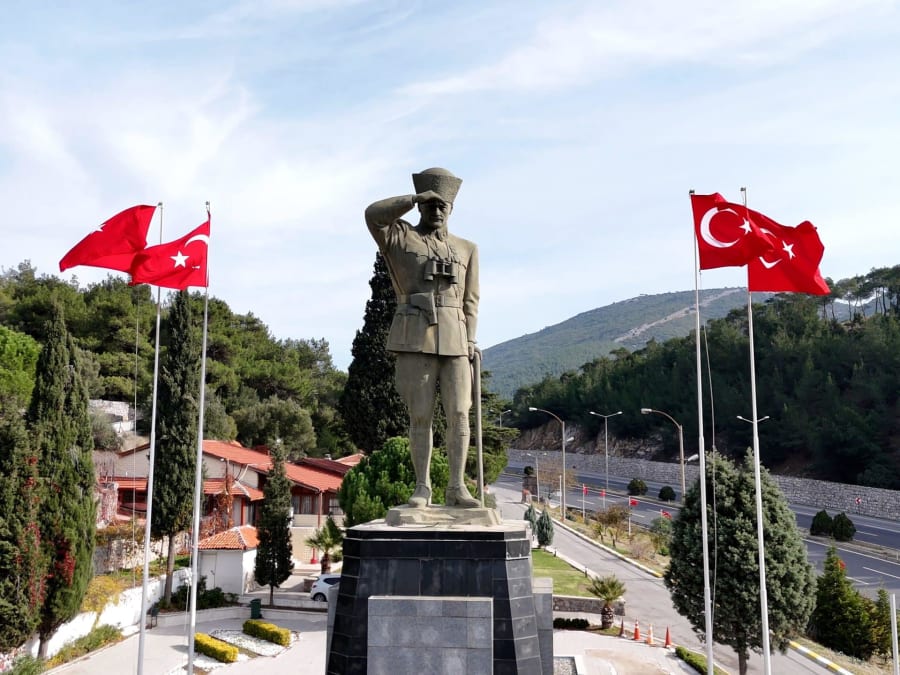
Belkahve, one of the strategic passes east of Izmir, holds a special place in Turkish history as the point where Mustafa Kemal Ataturk first gazed upon Izmir on September 9, 1922. Bornova Municipality opened the Belkahve Ata Memorial House Visitor Center on September 9, 2016, to keep this significance alive. The center offers visitors both the spirit of the War of Independence and the symbolic moment of Izmir's liberation...
 Bridge
Işıklar
The bridge is located at coordinates 38°25'27.65"N 27°14'0.20"E in Izmir – Bornova; Isikkent, Isiklar neighborhood, over Arap Deresi (Arab Creek). It is a main-arched bridge with slight slopes in both directions, featuring a total of two arches. The larger and higher opening, the main arch, indicates the main flow direction of the riverbed when the bridge was first constructed. A secondary arch supports flood water drainage...
 MuseumsCivil Architecture
Karaçam / Sabuncubeli
Established within a massive 520 m2 nomadic tent structure at the Sabuncubeli locality below Karacam Village, the center exhibits thousands of objects related to Yoruk Turkmen culture. Operating under the Izmir Yoruk Turkmen Federation, the center is open for free visits every day of the week.
 MuseumsCivil Architecture
Bornova Merkez
Located on Fevzi Cakmak Avenue, the Ege University Ethnography Museum houses a rich collection of Anatolian and Rumelian regional costumes as well as musical instruments from the Turkic world. The museum is notable for its artifacts reflecting cultural diversity.
 MuseumsCivil Architecture
Bornova Merkez
Opened in 2021, the Izmir Literature Museum Library offers a special collection featuring works and objects of Izmir-born authors, along with facsimile editions of manuscripts. Among the prominent exhibits are the first edition of Ataturk's Geometry book, a signed book by Halit Ziya, and Attila Ilhan's beret.
 MuseumsCivil Architecture
Bornova Merkez / EÜ Kampüsü
The second largest natural history museum established in Turkey, the Ege University Natural History Museum is also the country's first academic museum housed in a university building. Located on the Ege University Faculty of Science campus, it features a rich collection of fossils and rocks spanning 4.5 billion years of Earth's history. There is a symbolic admission fee.
 MuseumsCivil Architecture
Bornova Merkez
The Ege University Paper and Book Arts Museum presents the 2,000-year journey of the book through examples from different cultures. Displaying the world's smallest book and thinnest paper, the museum is one of the three major paper and book arts museums in the world.
 MansionsCivil Architecture
Bornova Merkez
Commissioned in 1865 by James Whittall for his daughter Jane and son-in-law Richard Wilkinson, Consul of Thessaloniki-Malaga-Manila, the mansion is one of Bornova's most distinguished Levantine buildings. Owned by the Wilkinson Family until 1985, the building was transferred to Ege University in 1997, restored in 2005, and named the "EU 50th Anniversary Mansion." Today it houses the EU Faculty of Fine Arts, Design, and Architecture.